Object Record
Images
Metadata
Object Name |
Map |
Source |
Library of Congress |
Iowa History Era Tag |
Statewide Settlement (1869-1896) |
Chronological Tag |
The Development of the Industrial United States (1870-1900) |
Catalog Number |
2018.056.016 |
Credit line |
Library of Congress- Washington, D.C. |
Description |
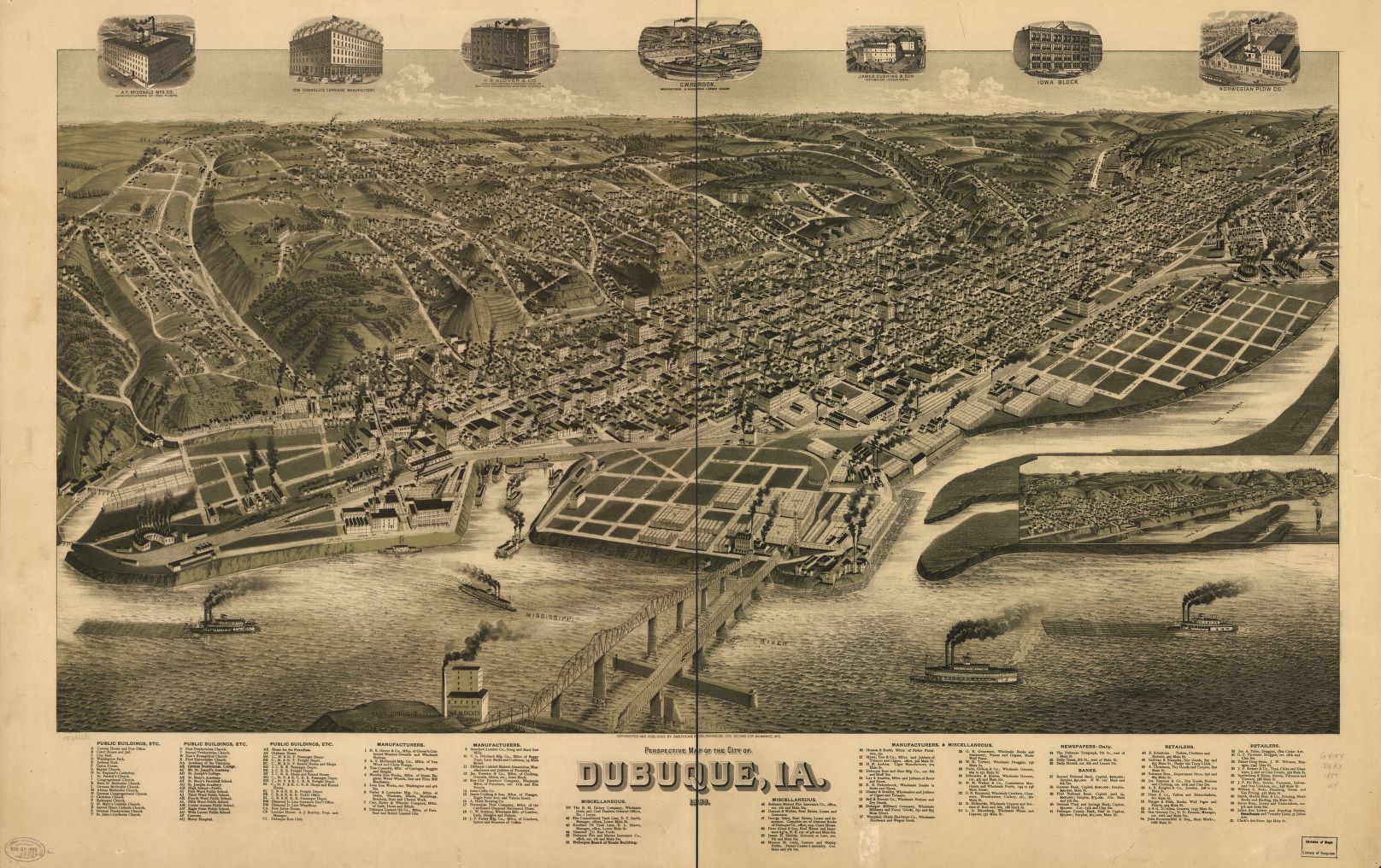
Perspective map of the city of Dubuque, Ia. 1889. Content can be used with the following standards: SS-Geo. 9-12.24 Iowans Influence Iowa Environment in a lesson on the establishment and settlement of Iowan towns. For any use other than instructional resources, please check with the organization that owns this item regarding copyright restrictions. |
Additional Research & Sources |
Established as Iowa's oldest city, Dubuque was founded by Julien Dubuque. Prior to his arrival in 1785, the area was occupied by the Mesquakie (Fox) Native Americans. Dubuque formed a relationship with the tribe through fur trade and learned of the lead mines that surrounded the area and Dubuque was given control of the mines (named the Mines of Spain). In 1833, the Black Hawk Treaty gave ownership of the land to the U.S. Government and the city of Dubuque was established. The city took on the nickname of the "Key City" as the mines allowed businesses and banks to open, and major industries to find success. The city grew in size as new residents, including Irish and German immigrants, moved to the area. The city saw the expansion of mining and fur-trading, along with industries of button making, boat building, logging, mill working, and meat packing. Along with the hopes of finding work, the riverfront also brought people to the city. However, over time the river began to lose its charm as environmental and industrial damage occurred. In the late 1990s, the America's River project was created to help re-build the riverside. The $188 million project helped to transform the riverfront to share the history and culture of the town. The project included the opening of the Mississippi Riverwalk, the National Mississippi River Museum and Aquarium, the Grand River Center, the Grand Harbor Resort, and the Star Brewery. |
Notes on Related Objects |
Object is related to the following library resources, which can be found by searching the catalog number in the advanced search section: Catalog #: 2018.045.032 The Worlds Between Two Rivers: Perspectives on American Indians in Iowa 2018.045.033 Inkpaduta: Dakota Leader 2018.045.034 Meskwaki History 2018.045.052- Iowa: Its History and Its Foremost Citizens 2018.045.065 White Racism on the Western Frontier: Dynamics of Race and Class in Dubuque 2018.045.066 Indians and Archaeology of Missouri 2018.045.072- The Story of Iowa: A Children's History 2018.045.075- One Hundred Topics in Iowa History 2018.045.083- A History of the People of Iowa 2018.045.078 The Middle West in American History 2018.045.085 I am a man; the Indian Black Hawk 2018.045.087- Iowa Through the Years 2018.045.094 From Ackley to Zwingle: The Origins of Iowa Place Names 2018.045.113- Bison Hunters of the Western Prairies: Archaeological Investigations at the Dixon Site 2018.045.116- The Indians of Iowa 2018.045.124- A Treasury of Iowa Tales 2018.045.129- Still Running: A Tribute to Maria Pearson, Yankton Sioux 2018.045.138- History of Iowa from the Earliest Times to the Beginning of the Twentieth Century 2018.045.138- History of Iowa from the Earliest Times to the Beginning of the Twentieth Century 2018.045.153- A River of Unrivaled Advantage: Life along the Lower Des Moines River 2018.045.184- Iowa: The Pioneer Heritage 2018.045.187- The Biographical Dictionary of Iowa 2018.045.143- Iowa Inside Out 2018.045.198- Mississippi River |
Primary/Secondary Source |
Significant - Local |
County Tag |
Dubuque |
People |
Dubuque, Julien |
Multimedia Links |
Click here to view/hear the file. |
Search Terms |
Cities Communities Early Explorers Environment People Road Systems Rural Life Native Americans Early Business and Industry Maps Bird's-eye view prints |
Legal Status |
Ownership of this resource is held by the Library of Congress and has been provided here for educational purposes only, specifically for use in the Iowa Museum Association's "Teaching Iowa History" project. It may not be downloaded, reproduced or distributed in any format without written permission from the Rights Holder. For information on U.S. and International copyright laws, consult an attorney. |