Object Record
Images
Metadata
Object Name |
Clipping, Newspaper |
Source |
Carnegie Cultural Center |
Iowa History Era Tag |
Statewide Settlement (1869-1896) |
Chronological Tag |
The Development of the Industrial United States (1870-1900) |
Catalog Number |
2018.017.009 |
Credit line |
Carnegie Cultural Center - New Hampton, Iowa |
Description |
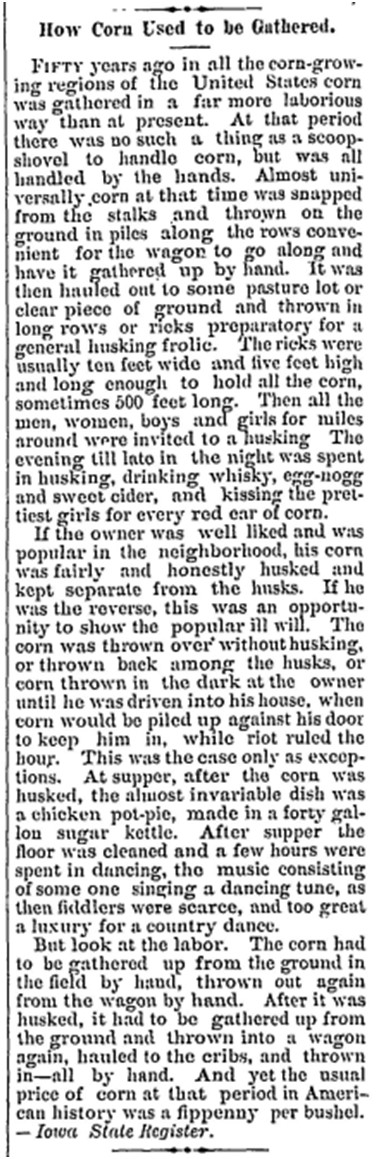
This newspaper article, printed in the New Hampton Courier in 1878, discusses how corn was harvested and husked fifty years before. According to the article, people from miles around a farm would get together and work together to husk corn. These gatherings often included dinner, dances and other activities. Content can be used with the following standards: 4th grade SS 4.26 Changes to Agriculture in a lesson on improvements and changes to farming techniques during the late 1800s and early 1900s. For any use other than instructional resources, please check with the organization that owns this item regarding copyright restrictions. |
Additional Research & Sources |
As described in the article, previous harvesting methods did not involve machinery but instead was all done by hand and transported with wagons. The harvested corn would be taken to an open pasture where surrounding families would gather to husk the corn together. This often turned into a social event with drinking and talking. If the owner of the pasture was well-liked, he would be left with a good deal of corn, however if he was not liked, corn would be thrown at him until he took shelter in his house, where then corn would be placed against his door to lock him in. After husking the corn, a dinner would be served and music played throughout the night. |
Primary/Secondary Source |
Secondary Source |
County Tag |
Chickasaw |
Multimedia Links |
Click here to view/hear the file. |
Search Terms |
Agricultural Products/Types Agriculture Communities Farmers/Farm Life Plants & Animals |
Legal Status |
Ownership of this resource is held by the Carnegie Cultural Center and has been provided here for educational purposes only, specifically for use in the Iowa Museum Association's "Teaching Iowa History" project. It may not be downloaded, reproduced or distributed in any format without written permission from the Rights Holder. For information on U.S. and International copyright laws, consult an attorney. |