Object Record
Images
Metadata
Object Name |
Print, Photographic |
Source |
Museum of Danish America |
Iowa History Era Tag |
Prosperity to the Depression (1897-1939) |
Chronological Tag |
The Emergence of Modern America (1890-1930) |
Catalog Number |
2018.048.001 |
Credit line |
Museum of Danish America - Elk Horn, Iowa |
Description |
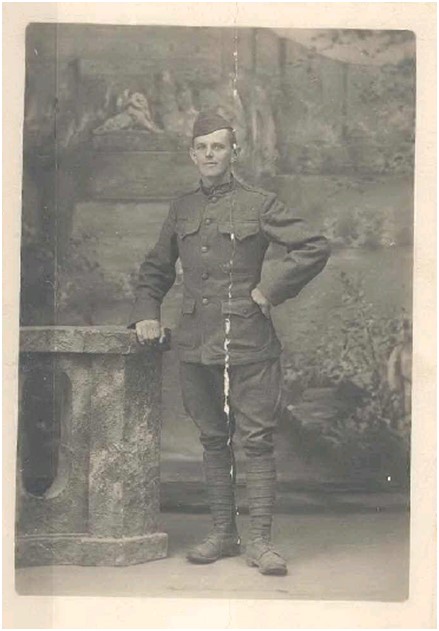
This photograph shows Danish immigrant Jens Peter Jensen in his United States Army uniform. Jensen joined the army in 1918 and completed basic training at Camp Dodge near Johnston, Iowa. After he completed training, Jensen served for 13 months in France at the end of World War I. After he was discharged from service, Jensen returned to Denmark to visit his family. While in Denmark, he met Johanne Jorgine Kristine Jensen. The two corresponded after he returned to the U.S. and he convinced her to immigrate. Jens and Johanne were married February 19, 1924, at the Elk Horn Lutheran Church. They farmed and raised their family near Elk Horn, Iowa. Jensen passed away in August 1970. Content can be used with the following standards: SS-WH 9-12.26 Iowans Influence World History in a lesson Iowans' experience as soldiers of WWI. For any use other than instructional resources, please check with the organization that owns this item regarding copyright restrictions. |
Additional Research & Sources |
When WWI broke out, the majority of Iowans were supportive of sending troops to fight. However, those who had immigrated from Germany were fearful of the United States fighting against their home country. Those who spoke out were claimed as traitors and faced discrimination in school and work. Despite the prejudice against German immigrants, all men between ages 18 and 45 were required to register at their county courthouse to meet the required quota. Camp Dodge and Fort Des Moines became the main training facilities in the state, with Fort Des Moines becoming the first in the country to train African-American soldiers. The war had major effects on Iowa when the government asked Iowan farmers to produce larger quanties food to supply the armies, thus raising crop prices. In addition to farms, people were asked to grow "Victory Gardens" to ration food, along with the enforcement of "Liberty Loans" to help troops. Iowans also donated largely to the Red Cross to help military hospitals and wounded soldiers. The end of the war resulted in 114,242 Iowan soldiers serving, with 3,576 casualties. |
Notes on Related Objects |
Object is related to the following library resources, which can be found by searching the catalog number in the advanced search section: Catalog #: 2018.045.071- A History of Danes in Iowa 2018.045.072- The Story of Iowa: A Children's History 2018.045.075- One Hundred Topics in Iowa History 2018.045.083- A History of the People of Iowa 2018.045.107- Danish Cedar Falls: The Immigrants' Experience 2018.045.136- Camp Dodge 2018.045.191- Iowa: The Home for Immigrants |
Primary/Secondary Source |
Significant - State/National |
County Tag |
Shelby |
People |
Jensen, Jens Peter Jensen, Johanne Jorgine Kristine |
Relation |
Show Related Records... |
Multimedia Links |
Click here to view/hear the file. |
Search Terms |
WW1 War & Conflict Immigrants War World War I Denmark Military uniforms |
Legal Status |
Ownership of this resource is held by the Museum of Danish America and has been provided here for educational purposes only, specifically for use in the Iowa Museum Association's "Teaching Iowa History" project. It may not be downloaded, reproduced or distributed in any format without written permission from the Rights Holder. For information on U.S. and International copyright laws, consult an attorney. |