Object Record
Images
Metadata
Object Name |
Clipping, Newspaper |
Source |
Muscatine Art Center |
Iowa History Era Tag |
Statehood and the Civil War Era (1847-1868) |
Chronological Tag |
Civil War and Reconstruction (1850-1877) |
Catalog Number |
2018.010.016 |
Credit line |
Muscatine Art Center - Muscatine, Iowa |
Description |
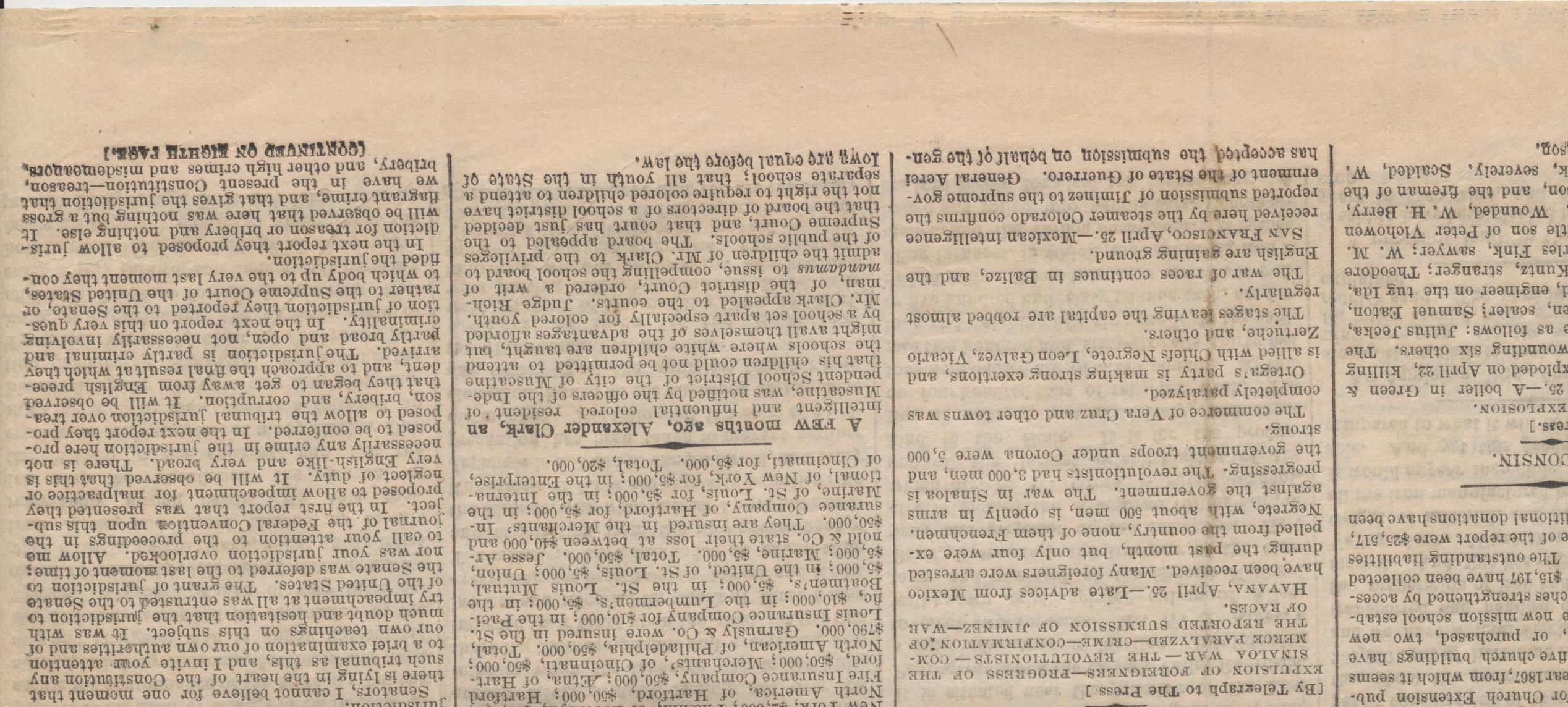
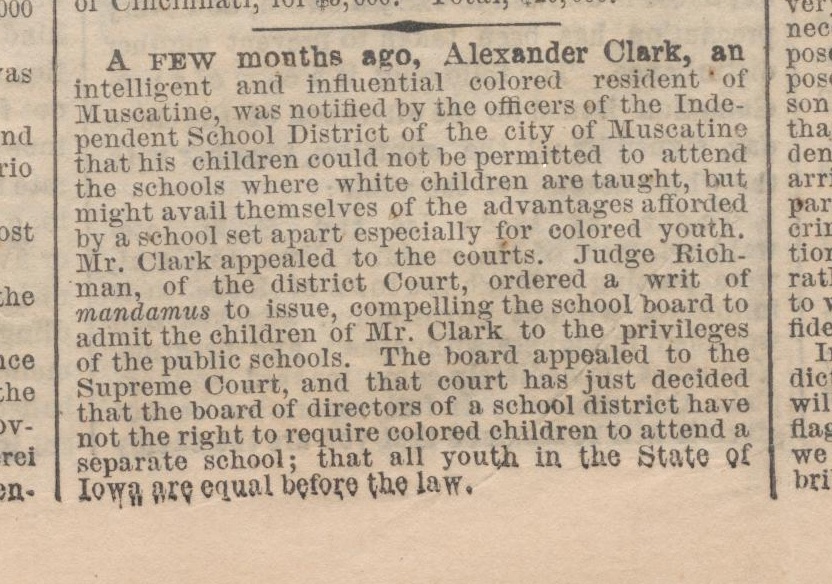
This short newspaper article discusses a Supreme Court ruling in favor of Alexander Clark over the Independent School District of Muscatine. Prior to this ruling, Clark sued the Muscatine school board on behalf of his daughter, Susan, after he was told she could not attend the same school as white children. The Supreme Court ruled that all children in Iowa were equal before the law, and this landmark case ended school segregation in Iowa. Content can be used with the following standards: 3rd grade SS 3.28 Cultural Contributions, 5th grade SS 5.26 Civil Rights, 8th grade SS 8.25 Iowa Governments, SS-Gov.9-12.28 Iowa Issues and Policy and SS-U.S. 9-12.23 Iowans Influence U.S. History. Lessons can be formed on Clarks' contribution to fighting for civil rights change in Iowa and the legislation changes regarding African-Americans during the late 1800s after the Civil War. For any use other than instructional resources, please check with the organization that owns this item regarding copyright restrictions. |
Additional Research & Sources |
With a job as a barber, Clark was able to meet influential white and black males of Muscatine, helping his voice be heard. He was also a friend of Fredrick Douglass during the 1840s. Muscatine became the largest African-American populated town in the state after many settled there after escaping the South or traveling eastward from other free states. Clark later established the African Methodists Episcopal Church in Muscatine, the first independent black domination in the United States. Clark was a fighter for civil rights and in 1855 signed a petition with state legislature that repealed a law that prohibited free blacks from entering the state. The repeal did not happen, and migration continued. Clark also fought for African-American right to vote and gained the right in 1868. For his children, Clark fought for equal education and sued his daughter's school after she was denied entrance due to her race. Clark won his Supreme Court case and as a result, Iowa became one of the first states to integrate schools. Clark was appointed U.S. Minister to Liberia by President Harrison in 1890, which became one of the highest-ranking appointments of an African-American by a president at that point of time. Clark died while in office of a fever in 1891. |
Notes on Related Objects |
Object is related to the following library resources, which can be found by searching the catalog number in the advanced search section: Catalog #: 2018.045.023- History of Education in Iowa 2018.045.025- Introduction to the History and . Government of Iowa 2018.045.030- Life Narratives of African Americans in . Iowa 2018.045.031- Iowa's Black Legacy 2018.045.036- The Negro in Iowa, with an Editorial Addendum Twenty Years After by William J. Petersen 2018.045.048 Social Legislation in Iowa 2018.045.062- Black Life on the Mississippi 2018.045.075- One Hundred Topics in Iowa History 2018.045.083- A History of the People of Iowa 2018.045.077- The Government of Iowa 2018.045.087- Iowa Through the Years 2018.045.106- Bright Radical Star: Black Freedom and White Supremacy on the Hawkeye Frontier |
Primary/Secondary Source |
Secondary Source |
County Tag |
Muscatine |
People |
Clark, Alexander |
Relation |
Show Related Records... |
Multimedia Links |
Click here to view/hear the file. Click here to view/hear the file. |
Search Terms |
African American Experience Civil Rights Education Government K-12 Education (Development of High Schools) People Lawmaking Supreme Court decisions Desegregation |
Legal Status |
Ownership of this resource is held by the Muscatine Art Center and has been provided here for educational purposes only, specifically for use in the Iowa Museum Association's "Teaching Iowa History" project. It may not be downloaded, reproduced or distributed in any format without written permission from the Rights Holder. For information on U.S. and International copyright laws, consult an attorney. |