Object Record
Images
Metadata
Object Name |
Bag, Seed |
Source |
Carnegie Cultural Center |
Iowa History Era Tag |
Prosperity to the Depression (1897-1939) |
Chronological Tag |
The Emergence of Modern America (1890-1930) |
Catalog Number |
2018.017.002 |
Credit line |
Carnegie Cultural Center - New Hampton, Iowa |
Description |
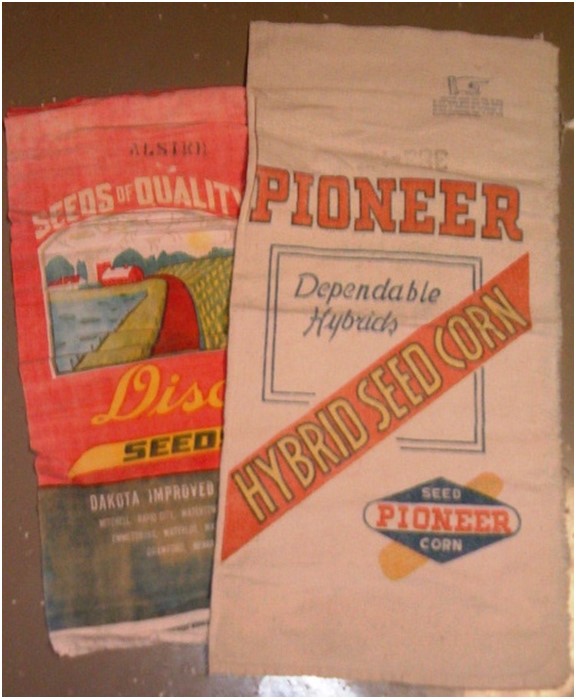
Cloth seed bags such as these ones were used to hold hybrid seed corn. Hybrid seed corn became very popular in the early 1930s, and it was sold by many companies. The cloth bags typically held one bushel of seed corn. In the late 1950s, paper sacks replaced cloth bags as the primary methods of storing and selling seed corn. Content can be used with the following standards: 4th grade SS 4.25 Changes to Agriculture and SS-Econ. 9-12.24 Iowa Impact on Economy in a lesson on new inventions and practices that helped agriculture in Iowa. For any use other than instructional resources, please check with the organization that owns this item regarding copyright restrictions. |
Additional Research & Sources |
Hybrid seed corn involves the planting of two types of seed rather than a variety. Two types of seeds are planted to create a cross-bred crop. This results in a new hybrid seed that can be specialized to help with drought resistance and to help crops grow in specific climates and weather conditions. Corn was the first crop to be modified this way and soon grew extremely popular in the market. Companies such as Pioneer Hi-Breds in Des Moines, IA took on this practice, and were the first commerical company to use the new strategy of planting in 1926. |
Primary/Secondary Source |
General primary source |
County Tag |
Chickasaw |
Multimedia Links |
Click here to view/hear the file. |
Search Terms |
Agricultural Products/Types Agriculture Business & Industry Farmers/Farm Life Agricultural equipment Seeds |
Legal Status |
Ownership of this resource is held by the Carnegie Cultural Center and has been provided here for educational purposes only, specifically for use in the Iowa Museum Association's "Teaching Iowa History" project. It may not be downloaded, reproduced or distributed in any format without written permission from the Rights Holder. For information on U.S. and International copyright laws, consult an attorney. |