Object Record
Images
Metadata
Object Name |
Map |
Source |
Library of Congress |
Iowa History Era Tag |
Statewide Settlement (1869-1896) |
Chronological Tag |
The Development of the Industrial United States (1870-1900) |
Catalog Number |
2018.056.015 |
Credit line |
Library of Congress- Washington, D.C. |
Description |
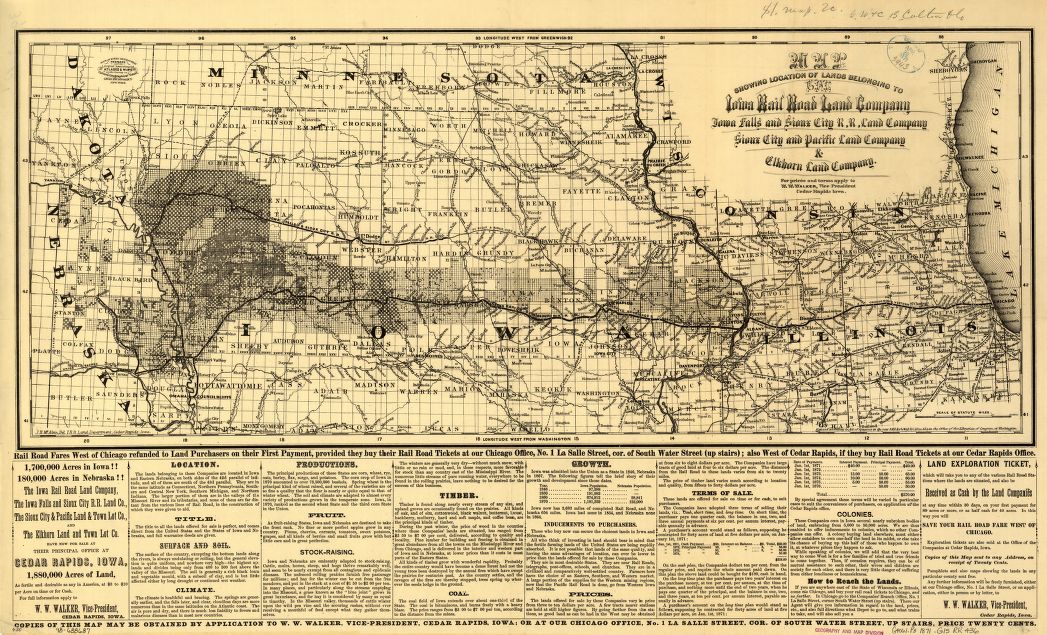
Map showing location of lands belonging to the Iowa Rail Road Land Company Iowa Falls, and Sioux City R.R. Land Company Sioux City, and Pacific Land Company & Elkhorn Land Company, J. T. McAlvin, Del. I.R.R. Land Department, Cedar Rapids, Iowa, 1871. The expansion and development of the railroad in Iowa opened the state for settlement, created towns along the line, contributed to the growth of agricultural and stock farms by taking products to market, contributed to the growth of service industries such as hotels and restaurants by bringing travelers and settlers to communities. Content can be used with the following standards: SS-Geo. 9-12.24 Iowans Influence Iowa Environment and 4th grade SS 4.25 Technological Changes in a lesson on maps created for railway use. For any use other than instructional resources, please check with the organization that owns this item regarding copyright restrictions. |
Notes on Related Objects |
Object is related to the following library resources, which can be found by searching the catalog number in the advanced search section: Catalog #: 2018.045.162- History and Legends of Place Names in Iowa 2018.045.173- Iowa Route: A History of the Burlington, Cedar Rapids & Northern Railway 2018.045.175- Steel Trails of the Hawkeyeland: Iowa’s Railroad Experience 2018.045.176- The Hook and Eye: A History of the Iowa Central Railway 2018.045.194- Development of the Railroad in Iowa |
Primary/Secondary Source |
Significant - State/National |
Relation |
Show Related Records... |
Multimedia Links |
Click here to view/hear the file. |
Search Terms |
Rail Early Business and Industry Early Transportation Maps Railroads |
Legal Status |
Ownership of this resource is held by the Library of Congress and has been provided here for educational purposes only, specifically for use in the Iowa Museum Association's "Teaching Iowa History" project. It may not be downloaded, reproduced or distributed in any format without written permission from the Rights Holder. For information on U.S. and International copyright laws, consult an attorney. |