Object Record
Images
Metadata
Object Name |
Receipt |
Source |
Amana Heritage Society |
Iowa History Era Tag |
Statehood and the Civil War Era (1847-1868) |
Chronological Tag |
Civil War and Reconstruction (1850-1877) |
Catalog Number |
2018.040.011 |
Credit line |
Amana Heritage Society - Amana, Iowa |
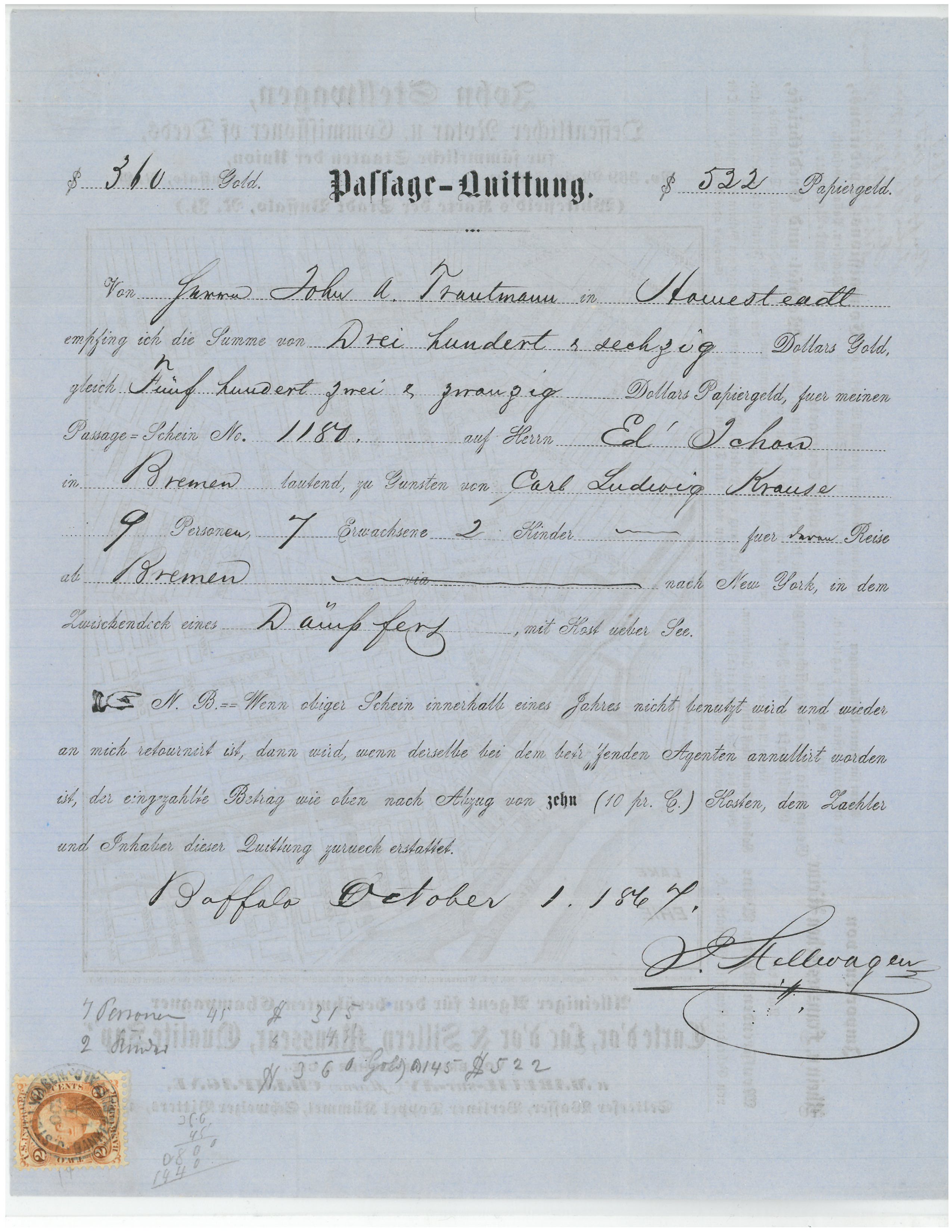
Description |
After founding the Amana Colonies in Iowa County, the Community of True Inspiration paid the passage fees for many of its members to travel to the United States. This passenger receipt certified the payment for 9 people to sail as passengers across the Atlantic Ocean. The receipt reads: "Mr. John A. Trautmann in Homestead, I have received the sum of $360 in Gold, equal to $522 paper currency, for my passenger certificate No. 1180 to Mr. Ludwig Krause; 9 persons—7 adults and 2 children, for their passage from Bremen to New York, on the second deck of a steamship, with meals provided at sea. Buffalo (New York) October 1, 1867 Signed, J. Hollwagen" Content can be used with the following standards: 3rd grade SS 3.27 Immigration and Migration in a lesson on German immigrants in Iowa during the late 1800s and the contributions they made to the state. For any use other than instructional resources, please check with the organization that owns this item regarding copyright restrictions. |
Additional Research & Sources |
The Community of True Inspiration was a religious organization founded in 1714 under Eberhard Ludwig Gruber and Johann Friedrich Rock near Himbach, Germany. The group followed the religious formations of Pietism which focused on Bible study, prayer and meeting the spiritual needs of the people by connecting to God. The group was met with controversy as the members did not take part in military duties and sent their children to church-led schools. To escape prejudice, group moved short-term to Buffalo, New York before settling in Iowa. The village was named "Amana", meaning "remain true" from Song of Solomon 4:8. The first Amana Colony in Iowa was founded in 1854 by 800 immigrants from Germany who formed the Society of True Inspirations. Described as a utopian-style organization, the group created a communal society that supported the religious and specific lifestyle that had been persecuted against in Germany. After arriving in Iowa, the colonies expanded to 7 villages spread over 26,000 acres and the residents created an economic living by establishing small businesses such as shops, bakeries, wineries, and through small factories creating furniture and other household items. The society also found work in farming. All residents were guaranteed food, shelter, money and health care in the communal setting, along with being provided a stable retirement plan. Families lived in apartments that were assigned to each family by the elders of the community depending on how new the family was and the size of the family. All buildings in the community were organized in a central pattern to create close connections with each other and in agreement that all property was shared. The religious beliefs of the Amana residents focused on giving care and primary focus to the elderly. Housing was made to benefit the elderly by allowing them to live closer to their families and by creating an economic system that provides longterm care for the elderly. |
Notes on Related Objects |
Object is related to the following library resources, which can be found by searching the catalog number in the advanced search section: Catalog #: 2018.045.096- History of Iowa County, Iowa and Its People 2018.045.178- Iowa’s Proud Heritage 2018.045.181- Uniquely Iowa 2018.045.191- Iowa: The Home for Immigrants 2018.045.192- Iowa: The Definitive Collection |
Primary/Secondary Source |
Significant - State/National |
County Tag |
Iowa |
People |
Trautmann, John P. Krause, Ludwig |
Relation |
Show Related Records... |
Multimedia Links |
Click here to view/hear the file. |
Search Terms |
Communal Groups Immigrants Passengers Amana Colonies Community of True Inspiration |
Legal Status |
Ownership of this resource is held by the Amana Heritage Society and has been provided here for educational purposes only, specifically for use in the Iowa Museum Association's "Teaching Iowa History" project. It may not be downloaded, reproduced or distributed in any format without written permission from the Rights Holder. For information on U.S. and International copyright laws, consult an attorney. |