Object Record
Images
Metadata
Object Name |
Trunk |
Source |
Iowa Jewish Historical Society |
Iowa History Era Tag |
World War II to an Urban State (1940-1963) |
Chronological Tag |
Postwar United States (1945-1970s) |
Catalog Number |
2018.014.017 |
Credit line |
Iowa Jewish Historical Society - Waukee, Iowa |
Description |
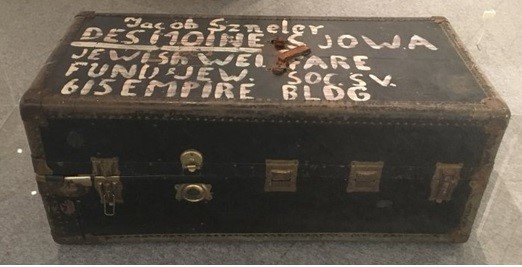
Polish native Jacob Szneler and his family used this trunk to carry their belongings when they immigrated to Des Moines, Iowa, in 1950. Szneler and his future wife were imprisoned at the Bergen-Belsen concentration camp in northern Germany during World War II. They were saved when British soldiers liberated the camp in 1945. In 1950, the Szneler family settled in Des Moines with the help of the Jewish Federation of Greater Des Moines. Content can be used with the following standards: 3rd grade SS 3.26 Immigration and Migration and SS-US 9-12.26 Iowans Influence World History in a lesson on survivors of WWII and their experiences and journey to Iowa. For any use other than instructional resources, please check with the organization that owns this item regarding copyright restrictions. |
Additional Research & Sources |
While in the Bergen-Belsen camp, Szneler met his wife, Rose , who learned that Szneler had lost his entire family including his previous wife, children and parents. Szneler and Belsen were married in 1946 and lived in Bremen, Germany until moving to the United States in 1950.The couple had three children. |
Notes on Related Objects |
Object is related to the following library resources, which can be found by searching the catalog number in the advanced search section: Catalog #: 2018.045.051- Des Moines, Together with the History of Polk County 2018.045.098- Centennial History of Polk County, Iowa |
Primary/Secondary Source |
Significant - State/National |
County Tag |
Polk |
People |
Szneler, Jacob |
Relation |
Show Related Records... |
Multimedia Links |
Click here to view/hear the file. |
Search Terms |
Immigrants War & Conflict WW2 Concentration camps Nazis |
Legal Status |
Ownership of this resource is held by the Iowa Jewish Historical Society and has been provided here for educational purposes only, specifically for use in the Iowa Museum Association's "Teaching Iowa History" project. It may not be downloaded, reproduced or distributed in any format without written permission from the Rights Holder. For information on U.S. and International copyright laws, consult an attorney. |