Object Record
Images
Metadata
Object Name |
Pointer |
Source |
Iowa Rural School Museum of Odebolt |
Iowa History Era Tag |
Statewide Settlement (1869-1896) |
Chronological Tag |
The Development of the Industrial United States (1870-1900) |
Catalog Number |
2018.036.006 |
Credit line |
Iowa Rural School Museum of Odebolt - Odebolt, Iowa |
Description |
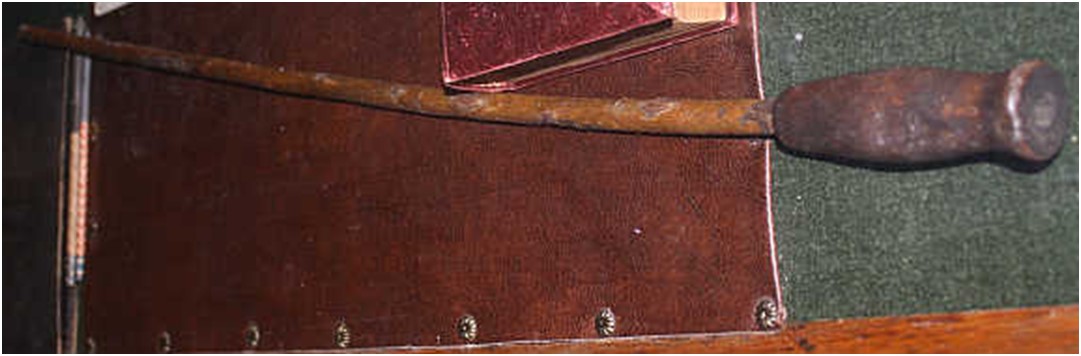
Teachers in one-room schoolhouses used pointers like this one help educate their students by pointing out important things they wrote on the school's blackboard. In some cases, pointers were also used to "lash" the knuckles of students who misbehaved; however, this practice was banned in several areas of the country. Content can be used with the following standards: 3rd grade SS 3.28 Cultural Contributions and SS Gov. 9-12.28 Iowa Issues and Policy in a lesson on court cases regarding education in Iowa. For any use other than instructional resources, please check with the organization that owns this item regarding copyright restrictions. |
Additional Research & Sources |
Schools in Iowa during the 19th and 20th century were allowed to physically discipline students using items such as this pointer. In the 1977 Supreme Court Case, Ingraham v. Wright, it was ruled that corporal punishment in public schools did not violate the 8th amendment of cruel and unusual punishment. Corporal punishment was allowed in Iowa schools until 1989 when the intentional physical punishment of students was banned throughout the state. |
Notes on Related Objects |
Object is related to the following library resources, which can be found by searching the catalog number in the advanced search section: Catalog #: 2018.045.023- History of Education in Iowa 2018.045.182- A New Look at Iowa One-Room Schools 2018.045.183- Iowa History of the One Room School |
Primary/Secondary Source |
General primary source |
Multimedia Links |
Click here to view/hear the file. |
Search Terms |
One-room Schools K-12 Education (Development of High Schools) Teaching |
Legal Status |
Ownership of this resource is held by the Iowa Rural School Museum of Odebolt and has been provided here for educational purposes only, specifically for use in the Iowa Museum Association's "Teaching Iowa History" project. It may not be downloaded, reproduced or distributed in any format without written permission from the Rights Holder. For information on U.S. and International copyright laws, consult an attorney. |