Object Record
Images
Metadata
Object Name |
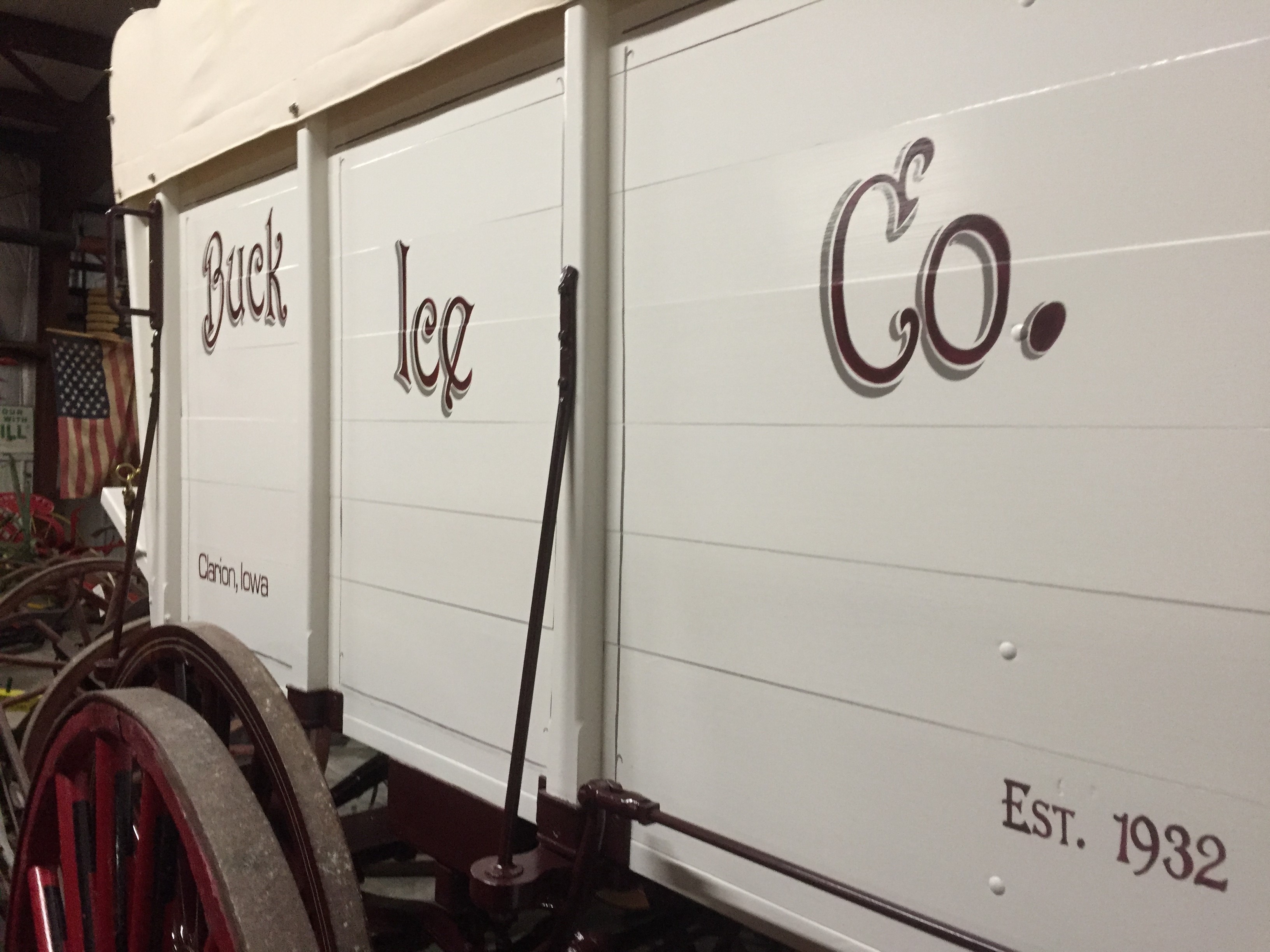
Wagon, Ice |
Source |
Heartland Museum Foundation |
Iowa History Era Tag |
Prosperity to the Depression (1897-1939) |
Chronological Tag |
The Great Depression and World War II (1929-1945) |
Catalog Number |
2018.054.006 |
Credit line |
Heartland Museum Foundation- Clarion, Iowa |
Description |
When only the very well off had refrigerators - merchants, bankers, professional people maybe- most folk had an ice box. Ice would be delivered one day a week. A large square white card with the word ICE in the center of the card and 25-50-75-100 on the sides was put in the front window. This told the ice man how much ice was wanted. The ice truck was originally a wagon pulled by a team of horses. A man with bulging muscles wearing a rubber tunic over his undershirt would throw his tongs over a cake of ice, drag it out and hang it on the scales at the back of the wagon. He'd chip away at the chunk with his ice pick until it was the right weight. Kids would enjoy watching, hoping to catch slivers of ice to suck on. The ice was then put into a box on the porch or some houses had a small door in the kitchen wall and an opening directly into the back of the ice box so the ice could be put directly in. Twenty-five pounds cost 20 cents; 50 pounds for 40 cents; 75 pounds for 60 cents and 100 pounds cost 75 cents. Content can be used with the following standards: SS-Econ. 9-12.24 Iowa Impact Upon Economy in a lesson on the ice trade. For any use other than instructional resources, please check with the organization that owns this item regarding copyright restrictions. |
Additional Research & Sources |
In a period before air conditioning and electric refridgerators, ice was essential in homes during the hot summer months. Used in the home for providing relief in the summer and during times of sickness, and to keep foods such as meat, eggs, milk and fruit from going bad, the "ice trade" during the 1800s help increased the ice harvest to transport ice to homes across the midwest. Nathaniel Jarvis Wyeth was a key figure to the increase in ice transportation, with his invention of a horse-drawn plow, whose blades cut the ice into movable ice blocks. The new standard ice blocks could be easily removed and stacked (using ice elevators) in ice houses constructed by Wyeth. These ice houses were insulated to keep the ice from melting throughout the winter. In the spring, the ice would be taken out and shipped on ice barges down the river to various cities. |
Notes on Related Objects |
Object is related to the following library resources, which can be found by searching the catalog number in the advanced search section: Catalog #: 2018.045.153- A River of Unrivaled Advantage: Life along the Lower Des Moines River |
Primary/Secondary Source |
Significant - Local |
County Tag |
Wright |
Relation |
Show Related Records... |
Multimedia Links |
Click here to view/hear the file. |
Search Terms |
Business & Industry Types of Business and Industries Ice industry Delivering |
Legal Status |
Ownership of this resource is held by the Heartland Museum Foundation and has been provided here for educational purposes only, specifically for use in the Iowa Museum Association's "Teaching Iowa History" project. It may not be downloaded, reproduced or distributed in any format without written permission from the Rights Holder. For information on U.S. and International copyright laws, consult an attorney. |